Home
Share Internet News
Share Internet News
XX Information Network - Domestic and foreign news, current affairs, strange things, and new things

Time:2019-09-25 15:30:02Click:
The United States will impose a 15% tariff on US$300 billion worth of Chinese goods exported to the United States starting in September. Mainland exporters and the logistics industry have been deeply affected. Some companies' profits have dropped by 30%, and some businesses have dropped by half. Some Hong Kong companies engaged in LCL business have stable business, attracting some mainland companies who want to reduce freight costs. However, multiple logistics companies revealed that Chinese exporters are increasing prices for both bulk commodities and cross-border e-commerce products, and American consumers will pay part or all of the tariff costs.
Hong Kong enterprises' LCL helps enterprises reduce costs and maintain stable business with the United States
The Shenzhen-Hong Kong logistics enterprises' National Day and Mid-Autumn Festival party held in Shenzhen recently attracted nearly 200 logistics and freight forwarding leaders and representatives from Shenzhen and Hong Kong. Regarding the huge impact of the Sino-US trade war, Yao Shuhong, general manager of Shenzhen Kunxin International Freight Forwarding Co., Ltd., said that the US tax on Chinese furniture has a great impact. He has several furniture customers in Shenzhen. Due to the trade war, their export volume has decreased by more than 15%. In the past, there were 300 containers shipped through them per month, but now there are only 250-260.

Yang Yunping said that the trade war will ultimately be paid by American consumers/Reporter Li Changhong Photo
Yang Yunping, general manager of Shenzhen Hongmingda Logistics, said that the trade war has had a greater impact on them. They are direct customers, mainly providing logistics services for exporting luggage, glass products, machinery and equipment to the United States. Their performance has declined by about 15% this year. In September, the United States will increase taxes by 15%, and the impact will be even greater. However, the products they serve are all mid-to-high-end, and their customers have good pricing capabilities. They adopt the OEM model for production and sales. In response to high tariffs, they require U.S. importers to bear part of the burden, entrust processing plants to bear part of it, and they themselves bear part of it, in order to resolve the pressure and challenges of the trade war. Therefore, American consumers will have to pay for the tariffs.
Cao Jingbo, vice president of Shenzhen Changfan International Logistics, said that the products they undertake are exported to the United States such as home appliances, clothes, shoes and hats, and 20,000 TEUs are shipped per year. Although the total volume is not small, it still accounts for a small proportion of the entire huge Sino-US trade volume. Because they mainly deal in daily consumer goods, the overall business is currently stable. But according to his understanding, the top ten logistics and freight forwarding companies in China’s exports to the United States have experienced a 40% decline in business. China's exports of high-tech products such as optical fiber and communications to the United States have also been greatly affected.
Su Feng, a person from Hong Kong company and Shenzhen New Mileage International Logistics, said that the Sino-US trade war has pushed up corporate costs, and those companies that export large quantities of full containers are under great pressure on transportation costs. Their company was one of the first to do bulk cargo consolidation business in Hong Kong in the 1990s. Because of its relatively low cost, it attracted many small and medium-sized exporters from the mainland and overseas. They have branches in the mainland, Hong Kong, Australia, Singapore and India. Due to the low transportation costs in this trade war, they have attracted some export companies who want to reduce costs. During the trade war for more than a year, their business has maintained steady development. They ship at least thousands of containers a year to many cities in the United States, such as Los Angeles, New York, and Miami. Los Angeles alone has 7-8 containers every week. The main commodities are clothing, small household appliances, electronic products, mobile phone accessories, and a small amount of molds.
Cross-border e-commerce companies are increasing prices, and American consumers are swallowing the bitter pill
Wang Yancheng, assistant general manager of Shenzhen Zhongjin International Freight Forwarding, which provides services for cross-border e-commerce companies, told reporters that many of their customers sell large quantities of daily necessities through the Amazon platform and export them to the United States. They are responsible for the distribution of goods. The main products include daily necessities, furniture, home appliances, etc. There are about more than 1,000 containers of goods exported to the United States a year. Since the trade war, their business volume has declined partially, but their profits have dropped significantly by 30%. After a year of testing in the trade war, some export companies have adapted at this stage. They directly increase the price of goods in the US market, otherwise they refuse to sell them. In the past, cross-border e-commerce companies were consuming their own profits, but now they are beginning to pass on the costs and require American consumers to foot the bill.
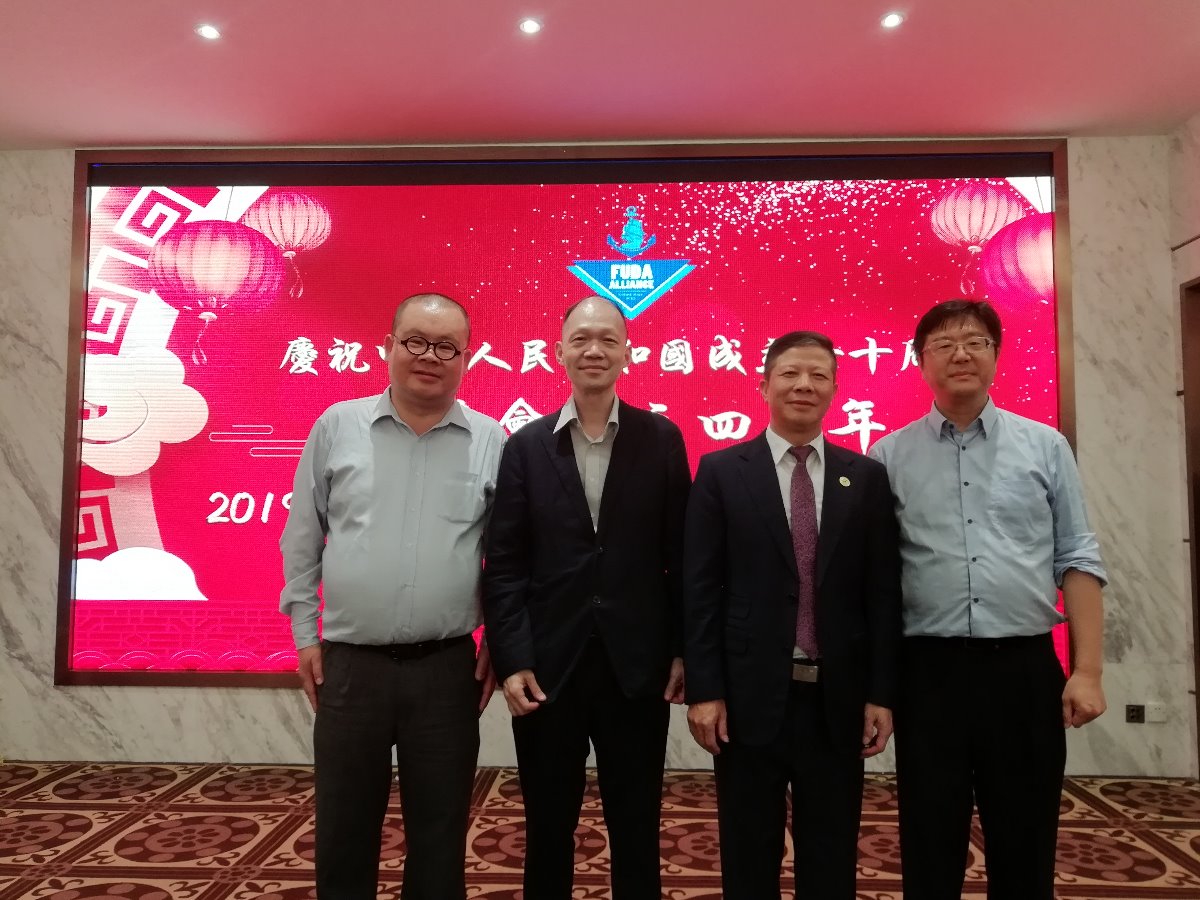
Huang Peng (first from left) said that they have logistics and warehousing services in the "One Belt and One Road" to provide services for the expansion of export enterprises in these countries/Reporter Li Changhong Photo
Tang Min, general manager of Shenzhen Wutongbao International Logistics, another company engaged in cross-border e-commerce logistics services, said that 80% of their business comes from cross-border e-commerce sellers. During this wave of trade war, they originally had 30 containers going to the United States every month, but now it has been reduced to 15 containers, a drop of 50%. However, as U.S. import tariffs continue to increase, Chinese sellers' costs are also increasing. In order to cope with operational pressure, their selling prices on the Amazon platform are also increasing, and American consumers ultimately foot the bill.
He said that the trade war may inhibit the export of Chinese goods in the short and medium term, but China is also powerful in countering the United States. In the first seven months of 2019, China's exports to the United States fell by only 2.1%, to about 30 billion yuan, while U.S. exports to China fell by 24%, a decrease of nearly 150 billion yuan. Therefore, the trade war hurts both sides, and the harm to the United States is greater, and the gains outweigh the losses.
Improving logistics efficiency, reducing costs, and expanding into Southeast Asia and the Belt and Road market
In response to the trade war, many export companies and logistics companies have been looking for ways to deal with it, including improving logistics efficiency, reducing costs, and shifting export business to Southeast Asia and countries along the "Belt and Road".

Cao Jingbo said that the top ten logistics and freight forwarding companies in China’s exports to the United States have experienced a 40% decline in business./Reporter Li Changhong Photo
Wang Yancheng, assistant general manager of Shenzhen Zhongjin International Freight Forwarding, told reporters that in order to help export companies cope with the impact of the trade war, they find ways to help companies save costs and improve the efficiency of logistics links, constantly optimize logistics links, and display and handover to customers through the Internet, thereby achieving cost savings. Through their efforts, they helped customers reduce their costs by approximately 10%. Many companies are actively exploring new markets in Southeast Asia or countries along the “One Belt, One Road” initiative.
Cao Jingbo, vice president of Shenzhen Changfan International Logistics, said that in response to the trade war, some export companies have increased their development of markets in Europe, Southeast Asia and Latin America. Some are assembled in factories in some Southeast Asian countries such as Cambodia, Vietnam and the Philippines to avoid the impact of US tax increases. Yang Yunping, general manager of Shenzhen Hongmingda Logistics, said that their customers are considering setting up factories in Southeast Asia, but they face problems such as skilled workers, output and quality.
Hong Kong companies strive to expand into the Southeast Asian market, and their business has doubled this year
Some Hong Kong companies are optimistic about the opportunities brought by the trade war to Southeast Asia. In addition, many Southeast Asian countries have experienced rapid economic development for more than ten years. Many Hong Kong companies have vigorously explored the regional market, and some companies have doubled their business this year.
Su Feng, a person from Hong Kong company and Shenzhen New Mileage International Logistics, said that in order to seize the business transfer opportunities brought by the trade war, they have increased the development of routes in Southeast Asia. Currently, the routes in this region are relatively complete and there are many shipping schedules. Affected by the trade war, their business in Southeast Asia, Vietnam and Qin has at least doubled since this year. The economy in Southeast Asia is developing relatively rapidly, and countries such as Vietnam and Cambodia are experiencing economic take-off.
Zhang Xuhua, the person in charge of Jincheng International Logistics, which has operations in the mainland and Hong Kong, said that they serve more than 20,000 TEUs of goods exported to the United States a year, but the trade war has caused their business to decline by 20 to 30%. Therefore, they have increased the development of the Southeast Asian market. Currently, their Southeast Asian business accounts for 70%, while the United States only has 1-30%.
Huang Peng, chairman of the Hong Kong company and East Express Group, said that they actively serve to help companies expand markets outside the United States. They provide overseas warehouse services for export companies through their overseas logistics agency network in Southeast Asia and other countries, allowing them to ship finished products in large quantities to warehouses in Southeast Asia and countries along the “Belt and Road”, and then distribute them to local customers based on their actual sales and needs. He said that they have 2,800 agents in 68 countries in Asia, Europe and Africa along the "Belt and Road", which can provide related services. In addition, they provide each manufacturer with monthly account deferral ranging from 15 to 30 days and support of RMB 200,000 to 500,000 yuan.
How Shenzhen and Hong Kong enterprises cope with the trade war
1. Help enterprises save costs and improve the efficiency of logistics links, and display and handover to customers through the Internet, thereby achieving cost savings;
2. Export companies set up factories and assembly plants in Southeast Asian countries, Cambodia and Vietnam;
3. Hong Kong companies strive to expand Southeast Asia routes and services, business has doubled this year;
4. A new milestone for Hong Kong enterprises in the United States LCL service, which reduces the logistics costs of export enterprises and attracts many small and medium-sized enterprises;
5. Hong Kong enterprises Dongji Express provides export enterprises with warehousing services in Southeast Asia and the "One Belt and One Road" through cooperation alliances.





