Home
Share Internet News
Share Internet News
XX Information Network - Domestic and foreign news, current affairs, strange things, and new things

Time:2019-09-25 11:02:02Click:
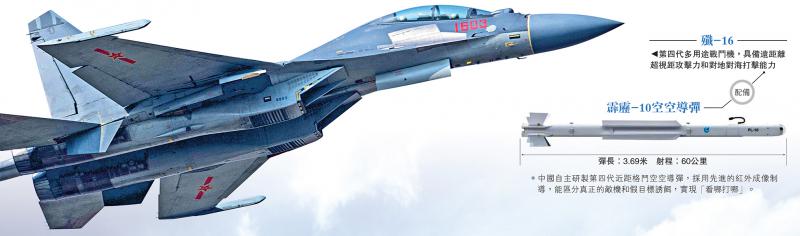
The J-16 fighter jet, which debuted at the Zhurihe military parade last year, is accelerating to form a comprehensive combat capability. In addition to forming formations with the J-20 and J-10C for collaborative combat training, it has also recently launched confrontation air combat training with the J-10 and J-11B. As a heavy-duty multi-purpose fighter with long-range beyond-visual-range attack capabilities and ground-to-sea strike capabilities, the J-16 is the second most important fighter aircraft in active service in the Air Force after the J-20. It is the core force in building a powerful air force with both offensive and defensive capabilities.
The J-16 is a new fourth-generation two-seat, twin-engine multi-purpose fighter developed on the basis of the J-11 fighter. It made its first flight in Shenyang in October 2011. At the Zhurihe Military Parade held on July 30 last year to celebrate the 90th anniversary of the founding of the People's Liberation Army, the J-16 made its first public appearance in a wedge-shaped formation of five aircraft. At present, the J-16 has been equipped with many fighter aviation units of the Air Force.
Capable of air combat and air-to-ship air-ground attack
On the eve of Army Day this year, J-16 fighters launched an air combat confrontation with J-10 and J-11B fighters in the eastern theater. The J-16 carried out air interception, tracking, positioning and attack on the Blue Army J-10, and engaged in combat from medium to close range. Previously, in May, the Air Force also organized collaborative tactical training for the J-20, J-16, and J-10C new fighter aircraft formations. This is an important step for the J-16 to accelerate the formation of actual combat capabilities.
The J-16 meets the Air Force’s needs for a heavy-duty fighter with a large range and large bomb load. As the leader among the fourth-generation aircraft, the J-16 has two major missions: gaining air superiority and conducting ground-to-ship attacks. The J-16 is equipped with a phased array radar, which also strengthens its air and sea search and detection capabilities. It can identify and attack multiple targets at the same time. It has long-range beyond visual range attack capabilities and can carry out air-to-air, air-to-ship, and air-to-ground attacks.
The J-16 is also equipped with a high-performance electro-optical targeting system, which can accurately detect and identify targets at a distance outside the defense zone, making it beyond the reach of enemy air defense weapons. At close range, the target can be clearly imaged, ranged, tracked, and laser irradiated to guide the attack.
12 external weapons such as small ammunition depots
The main mission of the J-16 fighter is still air control, but it has the functions of both a fighter and a light bomber. The J-16 has a maximum bomb load of 12 tons and up to 12 weapon attachment points. It is like a small missile depot, no less than an H-6 bomber. And because the J-16 has good flight performance, it does not need a special escort aircraft like a bomber, and its independent combat capability is strong.
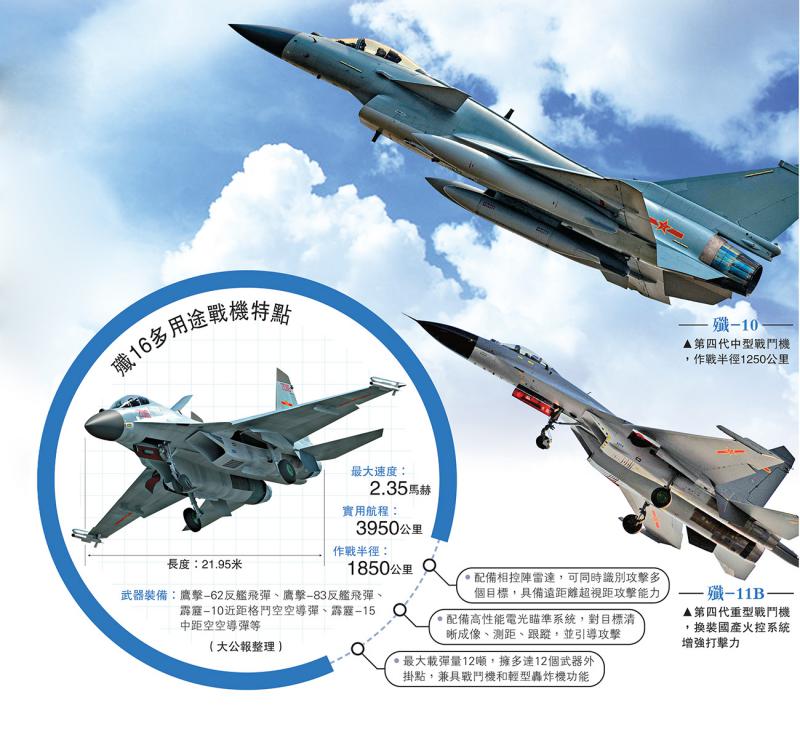
The J-16 can carry PL-10 short-range air-to-air missiles and PL-15 medium-range air-to-air missiles. In previous training, the J-16 also flew with a new type of ultra-long-range air-to-air missile. This type of missile is about 5 meters long. It can take advantage of the ultra-long range to attack key nodes of the enemy's early warning aircraft, tankers, large electronic warfare aircraft and other systems, and disrupt the enemy's air combat system. At the same time, the J-16 can also carry YJ-62 and YJ-83 missiles for anti-ship killing, and can also carry multiple types of bombs for ground attacks.
Because the J-20 is a "stealth assassin" and a "sharp sword" that undertakes strategic strike missions and specializes in hitting system hubs, it is not easily "unsheathed" in normal times. The J-16 will become the protagonist in daily maintenance and defense of territorial and maritime rights and interests. The J-16 has a practical range of 3,950 kilometers and a maximum speed of Mach 2.35. As a heavy fighter, its airborne time is far longer than that of medium-sized, single-engine fighters such as the J-10. Therefore, the J-10 focuses more on homeland air defense capabilities, while the J-16 is capable of long-distance and wide-range combat cruises. According to some information, China will equip 200 to 300 J-16s in the future, which will create a powerful aerial "wolf pack" and become the core force of the Air Force for both offensive and defensive operations.
J-20 leads the Three Musketeers in air combat
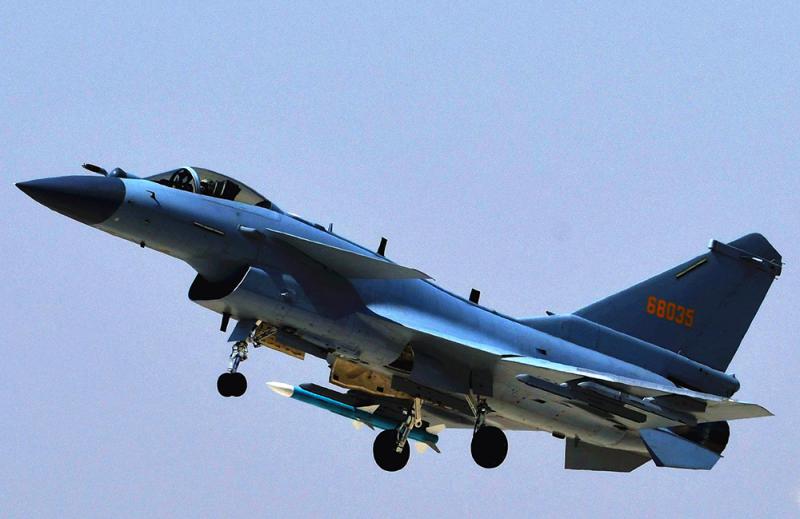
Picture: The J-20 uses its own situational awareness and stealth advantages to gain local air supremacy/File photo
In February this year, the Chinese Air Force announced that the domestically produced fifth-generation stealth fighter J-20 has begun to be installed in air force combat units. A certain unit of the Air Force Aviation Corps, which was the first to field the J-20, quickly organized coordinated tactical training for the J-20, J-16, and J-10C new fighter formations to explore ways to improve the combat performance of the J-20.
During the training, a combat detachment composed of J-20, J-16, and J-10C fighter jets was mixed to perform offensive air control missions and verify offensive operations under mixed conditions. The J-20 is the most advanced fifth-generation fighter aircraft currently in service. Its speed, ceiling, range and stealth performance far exceed those of other aircraft. The J-16 is the fourth-generation heavy fighter with the largest bomb load, and the J-10C is a medium-sized multi-purpose fighter. The three have different advantages. In mixed operations, they can complement each other and maximize the advantages of each type of aircraft.
The entry of the stealth aircraft J-20 into the Air Force not only directly adds a "big killer" to the Air Force, but also brings new changes in the Air Force's combat methods. The J-20 not only has strong air combat advantages of its own, but can also play a key role in forming systematic combat capabilities for other fighters through its advanced equipment performance. The J-20 used its situational awareness and stealth advantages to seize local air supremacy, and then the J-16 and J-10C carried out long-distance precision strikes on ground targets.
In training and preparing for war, more and more pilots of the Air Force have acquired the ability to fly J-20, J-16, J-10C and other new fighter aircraft, becoming "all-rounders" in the sky. This provides manpower support for mixed operations of various aircraft types.
In accordance with the strategic goal of "integrated air and space, both offensive and defensive" deployed by the Central Military Commission, the Air Force must improve its air and space strategic strike, air and space defense, and air strategic delivery capabilities, and the J-20 is an important booster for the Air Force's strategic transformation.
The J-10C is even more powerful with long-range air-to-surface missiles
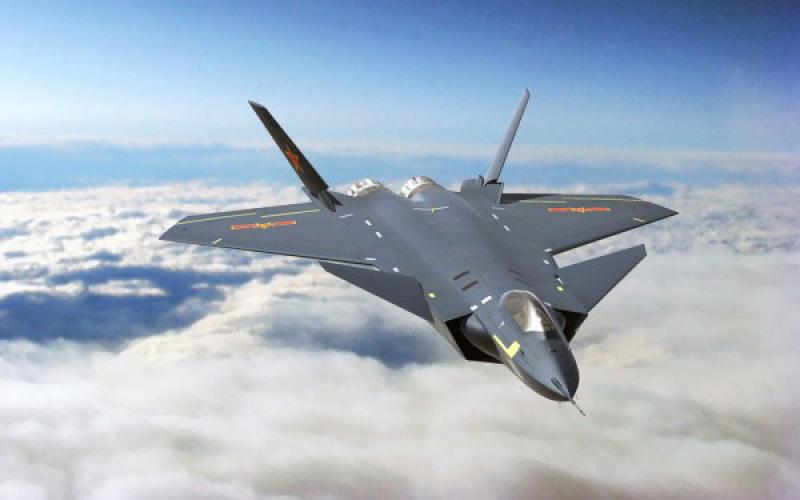
Picture: J-10C fighter jets conducting flight training/file photo
Like the J-16, the J-10C also made its first public appearance during the Zhurihe Military Parade in July last year. After several months of training, in mid-April this year, the J-10C officially began to assume combat duty, marking the further improvement of the Air Force's offensive and defensive combat system.
The J-10C is an improved supersonic multi-purpose fighter independently developed by China based on the J-10. It has medium and short-range air control and precise strike capabilities against ground and sea targets. Military expert Wang Mingzhi pointed out that the performance improvement of the J-10C is mainly reflected in three aspects. The first is sensors, which mainly refer to airborne radar and optoelectronic systems. Its advanced sensors are currently world-class. The second is avionics systems such as fire control computers, electronic equipment and electronic warfare systems. Third, the types of airborne weapons have been further increased, and multiple types of domestically produced advanced airborne weapons can be mounted.
What attracts the attention of the outside world is that the J-10C was equipped with KD-88 long-range air-to-ground missiles during recent training. The KD-88 is an air-to-ground missile independently developed by China. It can carry out "off-zone strikes", that is, using long-range air-to-ground weapons to launch attacks beyond the range of enemy air defense weapons without having to break into the blazing enemy air defense firepower network. Therefore, it can damage enemy targets while reducing the loss of one's own equipment and personnel.
The J-10C is mainly used to seize air superiority. After mounting the KD-88, it will greatly enhance the actual combat capability of ground strikes and have the ability to destroy key combat nodes such as enemy air defense missiles, command centers, and early warning radars. In turn, it is conducive to seizing air superiority and can also better perform mixed combat missions with the J-20 and J-16.
Quantum radar can make US stealth aircraft visible

Picture: Quantum radar detection renderings/network pictures
According to Sina Military Report: As a "clairvoyance" that can see the battlefield, quantum radar detection technology has become a research hotspot at home and abroad in recent years. Recently, the 14th Institute of China Electronics Technology Co., Ltd. reported another good news, completing a remarkable new test in a new technology field. Official reports recently revealed that China’s single-photon quantum radar has completed a long-range detection test. American think tanks believe that China is already at the forefront of the world in this field.
As early as November 2015, after completing the development of the quantum radar principle prototype, the development team conducted long-range detection tests in the northwest region of China. The test was ultimately a complete success, and the mainland's first radar prototype of the same type with a power exceeding 100 kilometers passed the acceptance inspection. In the following time, the research team of the 14th Institute of CETC continued to use new technologies to enable quantum radar to work during the day and complete long-distance detection tests in the daytime sea surface environment.
Recently, there is news in the United States that the US$717 billion in military expenditures in fiscal year 2019 will provide sufficient funds for the development of the B-21 stealth bomber. It is reported that the B-21's research and development must resolutely implement a strict confidentiality plan to ensure that when it is born, it can consolidate the "stealth" status of the US military and dominate the future battlefield.
However, the editor-in-chief of a US military website believes that the B-21 stealth bomber has great advantages in facing existing radar technology, but once it faces the Russian S-400 multi-band composite radar or China's quantum radar, it will easily be exposed.





