Home
Share Internet News
Share Internet News
XX Information Network - Domestic and foreign news, current affairs, strange things, and new things

Time:2019-09-25 11:01:11Click:
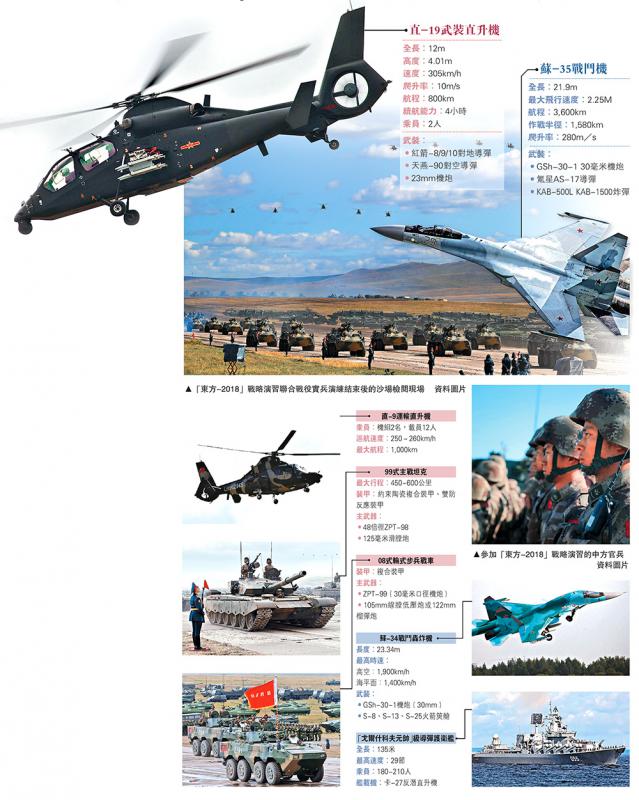
War eagles roared, and iron armor stretched horizontally. Last Saturday, the largest military exercise in Russia’s history, the “Vostok-2018” strategic exercise, came to a successful conclusion. In this strategic-level joint land, sea and air exercise, a series of heavyweight "star" equipment of the Chinese and Russian militaries were fully unveiled. The Russian army's Su-35 fighter jets, Su-34 bombers and the new Russian-made "Marshal Gorshkov" class guided missile frigates and other advanced main battle equipment can be said to be "out in full force". The Chinese army's Z-19, Z-9, 99 tanks, 08 infantry fighting vehicles and other modern equipment have a high degree of informatization, and the Russian military has given them thumbs up.
The "Oriental-2018" strategic exercise officially kicked off on the 11th. According to reports, the exercise used a large number of troops and weapons, reaching 300,000 personnel, more than 1,000 combat aircraft, helicopters and drones of various types, and nearly 80 ships. It covered a wide area, and the exercise was held simultaneously at 5 synthetic ranges, 4 air defense force ranges, and the waters of the Sea of Japan, Bering Sea and Sea of Okhotsk.
The Chinese side participated in the exercise with about 3,200 troops, more than 900 weapons and equipment of various types, and 30 fixed-wing aircraft and helicopters. It mainly practiced mobile defense, fire strikes, transition to counterattack and other subjects. China's JH-7 "Flying Leopard" fighter jets, Z-9, Z-19, 99 tanks, 08 infantry fighting vehicles, self-propelled rocket launchers and other advanced equipment also showed their talents in the exercise. Among them, the Z-19 is a new armed reconnaissance helicopter developed by China, and its reconnaissance system has reached the world's advanced level. The Type 99 main battle tank is China's third-generation main battle tank. It only takes 10 seconds to accelerate from parking to 42 kilometers per hour. It can launch 9M119 gun-launched missiles. The thickness of the vehicle body armor is equivalent to 1 to 1.2 meters of steel armor.
China’s advanced equipment attracts attention
Reports indicate that the Russian military is very curious about China’s new equipment. Li Shuyin, a member of the expert group of the "Oriental-2018" directing department and a researcher at the Academy of Military Sciences, also pointed out in the CCTV program that when communicating with Russian military officers and soldiers, when talking about the equipment of the Chinese army, the Russian military all gave a thumbs up, saying that the Chinese equipment is very advanced, especially the communication system has good performance.
During the exercise, all the Russian army’s advanced main battle equipment was deployed. The most eye-catching ones are the Su-35 fighter jets and Su-34 fighter-bombers in the air, the T-90 main battle tanks on the land, and the latest "Marshal Gorshkov" class guided missile frigates on the sea.
The Su-35 fighter jet, known as the "Super Flanker", was developed on the basis of the Su-27 fighter jet. It entered service in 2014 and is an improved model of the fourth-generation fighter jet. Foreign media reported that the Su-35 is equipped with a passive electronically scanned array radar that can detect air targets up to 400 kilometers away. The Su-34 fighter-bomber, nicknamed "Platypus", inherits the excellent aerodynamic design of the Su-27 fighter family and adopts many advanced equipment, such as new fire control computers, LCD displays, new data links, rear-view radar, etc.
The T-90 main battle tank is a third-generation main battle tank developed by Russia. Its main weapon is a 125mm smoothbore cannon with a maximum range of 5 kilometers. The T-90's photoelectric jamming system can work continuously for 6 hours and can effectively deal with American TOW, Dragon, Hellfire, Maverick and other missiles and laser-guided artillery shells.
On the sea, the Russian army dispatched the latest "Marshal Gorshkov" class guided missile frigate, which was just commissioned in July this year. The ship has a full load displacement of 5,400 tons, a length of 135 meters, a width of 16 meters, and a draft of 4.5 meters. It is the largest surface warship built by Russia after the disintegration of the Soviet Union. It integrates a variety of Russia's latest equipment and the most advanced systems, and the overall comprehensive combat capability is complete and powerful.
Sino-Russian military exercises in recent years
April 22 to 27, 2012
• "Maritime Joint-2012" was held in the waters near Qingdao, China. China and Russia dispatched 25 ships of various types, 13 aircraft, and direct 9 helicopters and special operations units participated in the exercise
July 5 to 12, 2013
• "Maritime Joint-2013" was held in Peter the Great Bay, Russia. The Chinese and Russian Communist Party dispatched 18 surface ships of various types, 1 submarine, fixed-wing 3 aircraft, 5 carrier-based helicopters and special operations units participated in the exercise
May 20-26, 2014
• "Maritime Joint-2014" was held in the sea and airspace of the northern part of the East China Sea east of the Yangtze River Estuary in China. The Chinese and Russian navies jointly dispatched 14 surface ships of various types, 2 submarines, 9 fixed-wing aircraft, as well as carrier-based helicopters and special operations units participated in the exercise
Mid-May and late August 2015
• "Joint Maritime-2015" first and second phases of the exercise Held in the Mediterranean Sea and the waters near Peter the Great Bay in Russia, the Chinese and Russian navies dispatched various types of surface ships, ship-based helicopters, special operations units, and amphibious equipment
September 12 to 19, 2016
•"Maritime Joint- 2016" was held in the airspace east of Zhanjiang, Guangdong. China sent 8 surface ships, 19 aircraft, some amphibious equipment, and marines
July 21 to 28, 2017
September 18 to 25
p>
•The "Joint Maritime-2017" exercise is divided into two phases, held in the Baltic Sea and Peter the Great Bay in the Sea of Japan to the southern waters of the Sea of Okhotsk
Experts: Exercise new models of future operations
"Vostok-20 Li Shuyin, a member of the expert team of the 18" Directorate and a researcher at the Academy of Military Sciences, pointed out that this "Vostok-2018" strategic exercise is different from previous joint exercises between the Chinese and Russian militaries. The topics of the exercises between the two sides have been expanded to traditional security topics of organizing joint defense and counterattack. The two militaries jointly completed the combat operation from defense to offense. There were many types of troops participating in the exercise, and all combat elements were integrated and commanded. In Li Shuyin's view, this exercise fully drew on the characteristics of modern warfare and practiced the combat mode of future wars.
According to the actual military exercise plan, officers and soldiers from China and Russia participated in the exercise to jointly eliminate "illegal" armed forces, implement defensive deployment, mobile operations, forcibly cross water barriers, fire strikes and joint counterattacks, etc. During the exercise, the joint director department jointly established by the strategic command agencies of China and Russia provided real-time command and guidance to the trained command agencies of both parties to complete joint operational planning, coordination, and command of troop operations and other exercise tasks.
Military observer Du Wenlong analyzed in a CCTV program that although China participated in a brigade-sized exercise operation, from the perspective of organizational command, including strategic-level communication, it has reached the headquarters level. In other words, from combat units to strategic organizations to campaign command organizations, all-round and multi-level connections are being made. If the two countries further integrate in combat operations in the future, learn from each other's strengths and overcome their respective problems through joint efforts, they will achieve higher development.





