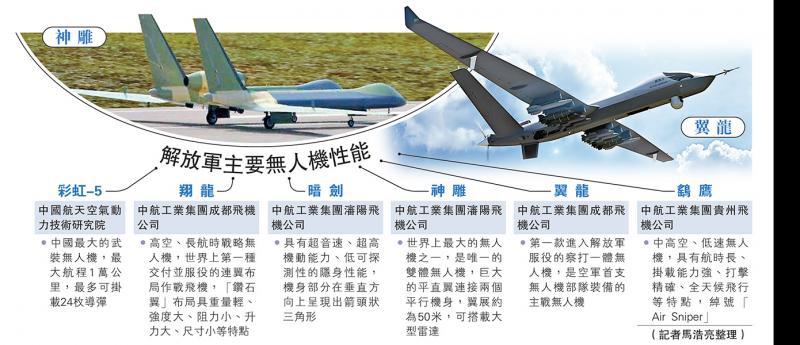
With the continuous improvement of military informatization and intelligence, military drones with medium-to-high altitude, long endurance, and integrated reconnaissance and strike capabilities have become an important new combat force of the Air Force. Military drones can not only be responsible for reconnaissance, monitoring, and jamming tasks, but also can carry missiles or bombs for aerial strikes. The People's Liberation Army's Rainbow, Wing Loong, Xianglong, Dark Sword, Divine Eagle, Harrier and other types of drones have become sharp swords that can kill thousands of miles away.
Recently, Rainbow-4 and Rainbow-5 drones have conducted intensive flight tests in the western plateau area. The two types of UAVs took off from a plateau airport at an altitude of 3,500 meters, breaking the take-off and landing altitude record of this type of UAV and verifying their ability to fly at high intensity in a plateau environment. According to Rainbow Company, after this verification, Rainbow-5’s plateau take-off and landing adaptability has covered most major airports in the world. It can be said that except for the North and South Pole, which has the harshest environment, Rainbow drones can be deployed globally.
The maximum payload of the Rainbow 5 is 1 ton.
The Rainbow-5 UAV completed its first flight in July last year. It is currently China's largest integrated surveillance and attack drone, with a wingspan of 21 meters, a maximum take-off weight of 3.3 tons, a maximum range of more than 10,000 kilometers, and a practical ceiling of 7,600 meters. It has the advantages of heavy fuel power, heavy load, long flight time, and long range. Rainbow-5 can simultaneously carry optoelectronic pods, lidar, hyperspectral cameras and other mission loads to perform tasks such as all-day reconnaissance and surveillance, patrolling, precise target positioning, and strike and damage effect assessment to provide support for military operations. It can also be equipped with a comprehensive electronic warfare system to perform communications reconnaissance jamming, radar reconnaissance jamming and other tasks, and carry out regional jamming and suppression of the enemy.
There are 6 hanging points under the wings of Rainbow-5, which can carry up to 24 different types of air-to-surface missiles or guided bombs at a time. The maximum load is 1 ton, and the load capacity is more than twice that of the previous Rainbow-4. In September last year, the Rainbow-5 UAV conducted a live-fire target shooting demonstration at an airport in northwest China. The weapons included AR-1 precision air-to-surface missiles and multiple types of precision guided bombs, all of which were successful. In addition, Rainbow can also cooperate with Rainbow-4 and others to form a drone cluster by sharing the same data link and control system to conduct joint attacks.
Shendiao Xianglong’s innovative combat layout
Currently, a variety of integrated surveillance and attack drones have entered the People’s Liberation Army’s service or completed their first flights, accelerating the formation of combat forces. These drones have different focuses on positioning and performance, forming a complete drone development layout as a whole. The Shendiao UAV is currently the only twin-body UAV in the world. Its huge straight wings connect two parallel fuselages, and the front of the fuselage is connected with a front wing to form a frame structure with better stress. It is also one of the largest drones in the world, with a length of nearly 30 meters, a wingspan of about 50 meters, and a take-off weight of more than 15 tons. It can carry large radars with its huge body.
The Xianglong UAV is a large, high-altitude, long-endurance strategic UAV, and the world's first continuous-wing combat aircraft delivered and put into service. The front and rear wings are connected to each other on the outside to form a rhombus-shaped "diamond wing" layout. It has the characteristics of light weight, high strength, low resistance, high lift, and small size.
The Xianglong UAV has a cruising altitude of 18,000 meters, a cruising speed of more than 750 kilometers per hour, and a battery life of 12 hours. During the standoff between China and India in Doklam last year, Xianglong drones were first equipped to the aviation unit of the Western Theater Air Force located at Shigatse Airport in Tibet. At the beginning of this year, Xianglong UAVs were equipped with the Southern Theater Command Naval Aviation Forces located on Hainan Island. This is important for monitoring and detecting military dynamics in the South China Sea and maintaining the South China Sea islands and reefs.Domain rights and interests are of great significance.
Main UAV performance of the People's Liberation Army
The J-20 wears the "Dark Sword" as an eye in the sky
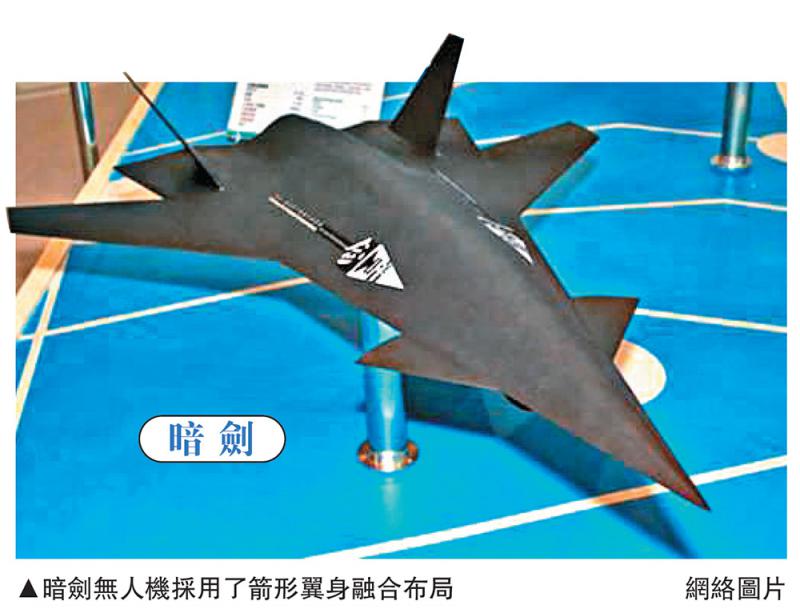
Picture: The Dark Sword UAV adopts an arrow-shaped wing-body fusion layout/network picture
According to the three-step plan of "shortening the gap, forming a system, and integrating air and space" formulated by the Chinese Air Force, UAVs are steadily becoming a new growth point to enhance the combat effectiveness of the Air Force. UAVs can not only perform integrated surveillance and combat missions alone, or form a mission formation, but can also cooperate with other fighter jets.
Military expert Major General Yin Zhuo pointed out that the drone can be controlled by the J-20 pilot and cooperates with the stealth drone. The drone is in front, detects the target, and informs the J-20 or J-20 formation of the number, height, direction and other data of enemy aircraft. The J-20 is behind the drone and can launch first without turning on the radar. The drone can also guide the missiles launched by the J-20 to improve the strike effect.
At the same time, the stealth and high speed of the J-20 have put forward higher requirements for UAVs.
In June this year, photos of the scientific research team taking photos with the Dark Sword drone were exposed online. The Dark Sword UAV was developed by Shenyang Aircraft Company. Its aerodynamic design adopts an arrow-shaped wing-body fusion layout, and the fuselage presents a triangle in the vertical direction.
At the same time, drones can also be integrated into complex combat systems as important nodes. In the 2016 "Red Sword" large-scale systematic confrontation exercise, the Wing Loong UAV was responsible for various tasks such as forward reconnaissance, air strikes, and combat assessment.
Another mid-to-high-altitude, low-speed, long-endurance surveillance and attack integrated UAV Harrier-2, nicknamed "Air Sniper" in English, was successfully tested in Guizhou in July this year. It has the characteristics of long endurance, strong mounting capacity, precise strike, and all-weather flight. It can be used for electro-optical image reconnaissance and surveillance, radar image reconnaissance, communication signal detection, etc.
"Pterosaur" hangs "Sky Thunder" to achieve air-to-ground strikes
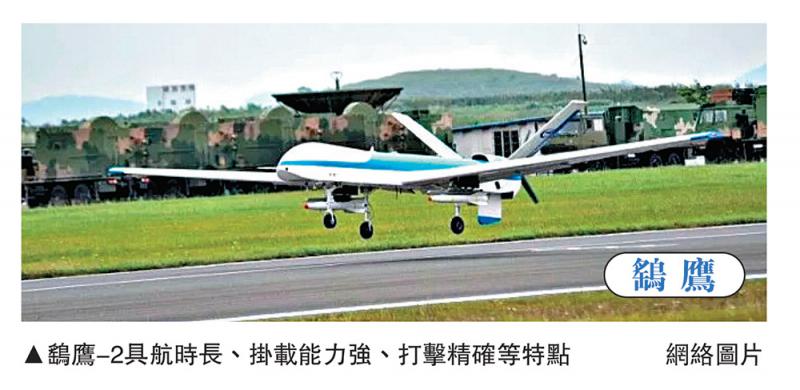
Picture: Harrier-2 has the characteristics of long flight time, strong mounting capacity, and precise attack/network picture
With the development of UAV technology, the requirements for target precision in modern operations are getting higher and higher, and it is gradually developing rapidly towards the integration of surveillance and attack. The Wing Loong-2 UAV is a large-scale reconnaissance and strike integrated multi-purpose drone independently developed by China. It is 11 meters long, has a wingspan of 20.5 meters, a maximum flight speed of 280 kilometers per hour, and a endurance of 20 hours, but its payload is doubled compared to the Wing Loong-1.
The Wing Loong-2 made its first flight in February last year. In December of the same year, it conducted a target shooting test in which five missiles of different types were continuously launched, setting a new record for domestic UAV target shooting tests. In February this year, the Tianlei-2 air-to-surface missile was successfully mounted and hit the bullseye 100%, showing its excellent attack power.
The Tianlei-2 missile was developed by the Fourth Research Institute of China Aerospace Science and Technology Corporation. It is a new type of airborne missile suitable for integrated surveillance and attack. The missile can be launched from multiple platforms such as helicopters and drones. It has the characteristics of light weight, small size, high accuracy, long range, controllable cost and strong portability. The Tianlei-2 missile adopts high-precision laser guidance and can achieve precise strikes against fixed-point clearing targets. Tianlei-2 meets the requirements for high-altitude, high-speed launch and complex electromagnetic environment of the Pterosaur-2 UAV, and has become the standard weapon of the Pterosaur-2.
As the "leading boss", Rainbow-5 has a strong load-carrying capacity, with a maximum external load capacity of 1 ton and 6 external pylons, which can carry up to 24 missiles, including Blue Arrow 7 laser-guided air-to-ground missiles, AR-1/AR-2 anti-tank missiles, etc. It can destroy an armored convoy or a tank company, and complete discovery, tracking and attack independently. It is known as the "tank hunter".
AR-1/AR-2 missiles are new UAV-specific air-to-surface missiles developed by China Aerospace Science and Technology Corporation. They are lightweight precision-guided weapons and can be used to attack tanks, armored vehicles, ground fortifications and water targets. The AR-1's armor-piercing capability is greater than 1,000 mm, while its penetration capability into reinforced concrete is 1,200 mm. The AR-2 missile is lighter, weighing only 20 kilograms, and has a maximum range of 8 kilometers.
Xianglong UAV is currently equipped with 4 types of ammunition including BA-7 laser semi-active guided air-to-ground missiles, Leishi-6 guided bombs, YZ-102A precision guided bombs, and YZ-121 laser guided bombs. Among them, the LS-6/50 micro 50kg guided bomb is the lightest type of the Leishi-6 series. It uses a retractable flying wing guidance assembly and is guided by a satellite navigation receiver and flight control drive system. It can be used to attack important fixed targets.
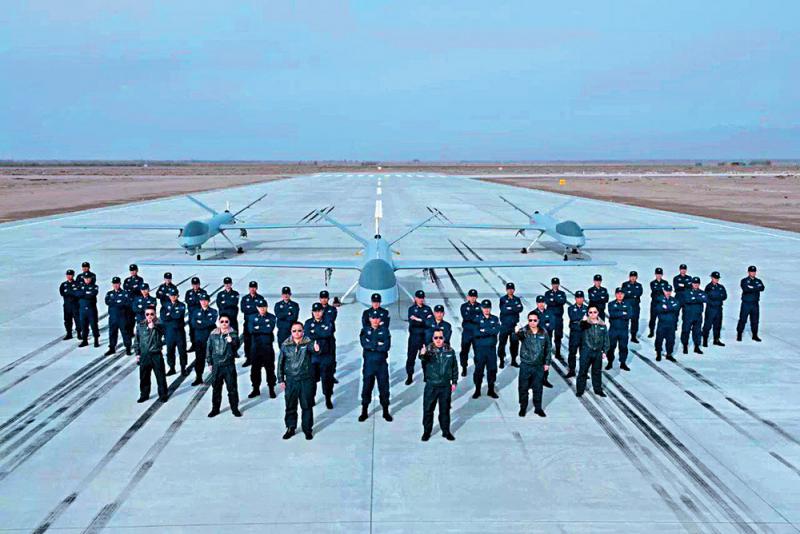
Ace pilot group drone unit
Picture: The People's Liberation Army Air Force UAV unit composed of ace pilots/data picture
Military large UAVs have complex control systems and fire control systems and can perform ultra-long-distance reconnaissance, strike and damage assessment missions. They are a new combat force in modern warfare. Their role in the modern air combat system continues to increase, affecting the transformation of future war patterns. In 2011, the Chinese Air Force established its first professional UAV unit. The pilots are all ace pilots with more than 3,000 hours of flying time, and many of them are Golden Helmet pilots. After the establishment of the unit, it has been transferred four times, and has been stationed at a command post of the former Nanjing Military Region Air Force, an aviation division of the Jinan Military Region Air Force, and a base of the Lanzhou Military Region Air Force. In 2014, it was transferred to the Air Force Experimental Training Base.
Drones are not truly “unmanned” and still require professional pilots to control them. Li Hao, the pilot of the first drone unit, was once an ace pilot flying a fighter jet. He once said that the biggest difference in controlling a drone is that when piloting a fighter jet, you can feel any abnormalities in the flight status of the aircraft through your body in real time, while when controlling a drone thousands of miles away, you can only detect changes in the surrounding airflow and flight attitude through subtle changes in the display screen. Moreover, all parameters of the drone are displayed on one panel, making it easy to get tired when operating for a long time. In the past, it was easy to fly a fighter plane at high altitude for two or three hours, but it would be dizzying to control a drone for one hour. However, a drone may sometimes hover over a target for more than 10 hours when performing a mission.
The first unit to be installed was the "Attack-1" (Pterosaur-1) drone. In the Air Force's "Red Sword-12" exercise, the Attack-1 completed high-altitude photography, target reconnaissance and image transmission tasks, which marked the formal integration of China's integrated reconnaissance and attack drones into the combat system. In the SCO "Peace Mission-2014" joint military exercise, the UAV unit controlled the Attack-1 and took the lead in discovering the Blue Army command vehicle in a strong electromagnetic interference environment, and successfully destroyed it after synchronizing and sharing intelligence. In January 2015, the first formation flight and joint combat test was completed. In 2016, the drone unit went out for training for the first time and truly achieved full combat effectiveness.