Home
Share Internet News
Share Internet News
XX Information Network - Domestic and foreign news, current affairs, strange things, and new things

Time:2019-09-25 10:30:29Click:
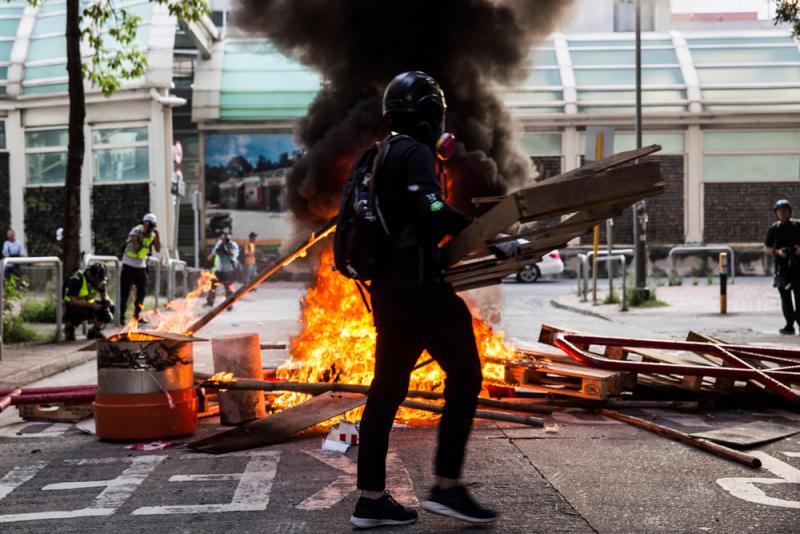
Picture: Hong Kong thugs burned roadblocks in Tuen Mun on September 21\AFP
Some people think they are making history, but in fact they are just repeating history. Street politics in Hong Kong have lasted for more than 100 days. The initial "anti-extradition bill" has evolved into a comprehensive "anti-China" movement. Incidents of burning the national flag, desecrating the national emblem, booing the national anthem, and challenging the bottom line of "one country, two systems" have become commonplace. "Hong Kong independence" is no longer a covert political demand of some people. Split and counter-split, infiltration and counter-infiltration, the struggle between the two major systems and ideologies of the socialist system and capitalism has become the main line and background of this movement. "
The term "color revolution" has not been around for a long time. It specifically refers to movements that have occurred around the world since the beginning of the 21st century, named after colors and flowers, and achieving regime change in a "non-violent" way. In Hong Kong, it is a political movement that uses black as the main color, uses anti-extradition law as the fuse, and uses anti-SAR government as its appearance, and its spearhead is directed at the central government's jurisdiction.
The United States is sowing color revolutions everywhere. Similar routines
There are differences and connections between color revolutions and "peaceful evolution". The difference is that peaceful evolution specifically refers to the ideological revolution launched against the socialist camp during the Cold War and aimed at subverting its regime. After the socialist movement fell into a low ebb, the United States dominated the world. The "peak loneliness" made him forget everything. If the war in Yugoslavia reflected the wanton behavior of the United States, then the war in Afghanistan was the strategic impulse caused by the panic and confusion of 911, and the war in Iraq was a revenge for his father, and the United States has paid a heavy price for this. Japan is still mired in the quagmire of war and cannot extricate itself, creating an embarrassing situation that it cannot win, escape, and cannot afford to delay. The Near East and the Middle East are becoming "the graveyard of empires."
Color revolutions are cheap, low-cost, and easy to operate. The United States is no longer keen on fighting a hot war, but is taking advantage of the situation and launching color revolutions. Its scope is no longer limited to socialist countries, but is global, especially in geopolitically sensitive areas. The frequency of color revolutions has increased significantly, and Central Asia and the Middle East are the most prominent.
A large number of non-governmental organizations funded by the United States have sprung up in geopolitically sensitive areas, becoming the sowers of color revolutions. Social networks are not only propaganda teams in peacetime, but also the best command platform for launching color revolutions in wartime. The deliberately cultivated local political elite has become a "Trojan horse" at critical moments. It is in this context that the so-called "Guidelines for Nonviolent Revolutionary Action" by Sharpe, director of the Einstein Institute for Peace at Harvard University, have been widely used and become a textbook for regime change in the early 21st century. This is why, looking around the world, people see that the color revolutions are all staged according to the same script, and their actions, gestures, slogans, symbols and routines for attacking powerful sectors are so strikingly similar. It is difficult for the same director to produce another style of political drama.
The third stage of the color revolution: Containing China
In the past 20 years, the color revolution has generally gone through three stages. The first stage was the color revolution that occurred in the former Soviet Union from 2003 to 2005, aiming to further compress the living space of the former Soviet Union. Especially after Putin came to power, the determination and will of major powers to recover have become apparent, and the United States has accelerated its efforts to cultivate its own agents in the region. As a result, Georgia’s “Rose Revolution”, Kyrgyzstan’s “Tulip Revolution” and Ukraine’s first “Orange Revolution” appeared in the former Soviet Union.
Around 2011, the color revolution entered its second stage, that is, regime change movements emerged one after another in West Asian and North African countries represented by the "Jasmine Revolution" in the Middle East. Some people believe that the color revolution in the Middle East is an endogenous revolution, but the role of external factors cannot be ignored. The "Greater Middle East Transformation Plan" launched during the Bush administration finally came to fruition during the Obama administration. As the U.S. financial crisis in 2008 fully spilled over to the world, prices skyrocketed and youth unemployment remained high in the Middle East. In December 2010, the self-immolation of a Tunisian university student vendor triggered a regime change movement that swept across the Middle East. Because Google played an extremely important role as a mobilization and command platform in this movement, using violent and non-violent methods alternately, the Jasmine Revolution is also called the "Internet Revolution."
With the rapid rise of China, the United States has launched the "Asia-Pacific rebalancing" strategy aimed at containing China. The color revolution has entered the third stage, with the goal of further compressing China's living space. One is targeting mainland China. After the Jasmine Revolution in the Middle East, some people clamored, "The pyramids have fallen, and the mummies have come to life; now we have to let the Great Wall fall and let the terracotta warriors and horses stand up." Second, a series of harbingers of color revolutions have also appeared in China’s surrounding areas. For example, Cambodia’s “Lotus Revolution” almost capsized Hun Sen’s ship. After many iterations of Myanmar's "Saffron Revolution", the NLD finally achieved fruition. However, after the pro-Western Aung San Suu Kyi came to power, she significantly revised the NLD's past anti-China line. China-Myanmar relations have become closer and closer, which was an unexpected failure of the United States. The third is to use China's Taiwan and Hong Kong issues to instigate the "Sunflower" movement and Hong Kong's "Occupy Central Movement." The political turmoil in 2019 in the name of anti-extradition law soon evolved into a "black revolution" in black shirts. Its essence is a continuation of the "Occupy Central" movement. Through the core demand of the five major demands, it strives for double universal suffrage, aiming to win the governance power from the central government and achieve complete autonomy, or "semi-independence" or even complete independence for Hong Kong.
Begging for beauty and sanctions is caused by colonial psychology
If the United States' support for the "Occupy Central Movement" in 2014 was still secretive, this time it jumped directly to the forefront. Hong Kong demonstrators were proud to hold high the British and American flags and sing British and American songs. These people continue to hold rallies and lobby in the United States, begging the United States to pass the "Hong Kong Human Rights and Democracy Act" as soon as possible to replace the United States' Hong Kong Policy Act. There are really not many people in the world who beg other countries to impose sanctions on themselves. This kind of behavior that repeatedly breaks the bottom line of citizens reflects the confusion of some Hong Kong people about the identity of Chinese nationals. The decolonization efforts have not made substantial progress. Colonialism is reflected in every aspect of Hong Kong society.
Hong Kong is not only the forefront of the strategic game between China and the United States, but also the intersection of the two major systems. Beautifying street violence and beautifying the civility of colonial rule is a common behavior in Hong Kong society. As the tension between China's system self-confidence, road self-confidence, and theoretical self-confidence further emerges, the confrontation and tension between Chinese and Western values and various forces are becoming more and more intense in Hong Kong. As the United States becomes increasingly disillusioned with China's peaceful political evolution, it is imperative that the United States adjust its policy toward Hong Kong.
The United States conspired to disrupt Hong Kong and hinder China's rise
Looking back at history, when the United States held a hearing on Hong Kong policy, the United States believed that "the close economic exchanges between Hong Kong and the mainland will definitely promote social and political changes within China." However, facts have proven that China has not integrated into the West politically. On the contrary, it has formed its own model, providing a "new choice" for the vast number of developing countries. The formation of the "Beijing Consensus" poses a major challenge to the "Washington Consensus" and forces the United States to rethink Hong Kong's positioning. Since Hong Kong cannot achieve the purpose of promoting China's political reform, the United States' adjustment direction of Hong Kong policy means that Hong Kong can no longer help China's rise. It must turn Hong Kong into a turbulent area and become a huge resistance to China's rise.
Linking trade and human rights is not a new practice, but has been throughout President Clinton’s eight-year term. Since the 1990s, the United States has talked about human rights every year and linked the extension of most-favored nation status to human rights issues. This page was not turned until China joined the WTO. The United States links the Sino-US trade agreement with Hong Kong human rights issues, which undoubtedly increases the fetters of the United States' China policy. In the end, it is creating a cocoon of its own.
Although Hong Kong is an international city, its international perspective needs to be expanded. There are fatal shortcomings in the macro-thinking and analytical framework of the younger generation. Looking at problems is often point-based thinking, lacking support from the perspective. For example, the documentary "Winter Fire" was widely circulated among demonstrators some time ago, and many young people burst into tears after watching it. Regardless of the motive behind the production of this propaganda video documenting the second color revolution in Ukraine, its content is extremely one-sided, not to mention that this color revolution, which killed and injured thousands of people, was an out-and-out "bloody revolution." After the revolution, Ukraine was in ruins, with the country and family destroyed. Ukraine, once a great breadbasket, has become the poorest country in Europe. However, young people in Hong Kong actually use such a country as a model, which highlights the shallow understanding of country knowledge among some young people in Hong Kong.
As social conflicts intensify, young people are easily incited
The strategic game between China and the United States is a protracted war, and it is destined that Hong Kong will remain calm but the wind will not stop. To sum up the common features of the global color revolution, it undoubtedly requires the mutual stimulation and catalysis of many factors. Intensification of social conflicts is the primary condition. The internal divisions within the regime, the high youth unemployment rate, the severe weakening of mainstream ideology, the emergence of opposition within the regime, the emergence of emerging media, the defection of powerful sectors, and the support of the United States and other Western countries are all important conditions for the occurrence of color revolutions. The long-lasting turmoil in Hong Kong can be said to be a general outbreak of social conflicts, especially polarization and the gap between rich and poor, which ranks first among developed economies. Although Hong Kong's unemployment rate is not high (2.9%), there is a clear lack of high-income industries. Many young people are engaged in jobs that "cannot support themselves". This is the most easily exploited force.
The disconnect between Hong Kong's law enforcement and judicial institutions is objectively not conducive to combating violent crimes, and may even condone crime, creating a systemic fault zone. But thankfully, so far, the police, as the most important and basic force in preventing the success of the color revolution, are still playing a pioneering role. Because of this, since the beginning of the movement, demonstrators have been quick to point their conflicts at the police. The political motive of the so-called "establishment of an independent investigation committee" among the five major demands is to push the police to the moral, political and legal tribunal, thereby completely destroying the will of powerful departments. This is precisely a major focus of the current struggle.
Looking at the characteristics of color revolutions in the past two decades, countries and regions where color revolutions have taken turns are often the most severely affected, and the degree of violence has also increased gradually. Kyrgyzstan "is bound to make trouble every spring", and Ukraine and Hong Kong are in trouble again and again. No one was killed or injured in the first Ukrainian "Orange Revolution", while hundreds died in the second revolution. In particular, the opposition hired gunmen from Georgia to shoot at police and demonstrators indiscriminately, causing further confrontation between the police and the people, and the situation took a turn for the worse. Some analysts believe that judging from the escalating trend of violence in Hong Kong, this day may not be too far away in Hong Kong.
We must take action against monopoly
Although it has been 22 years since Hong Kong returned to the motherland, many Hong Kong people are unwilling to face this reality. Some young people even believe that "it used to be a British colony, but now it has become a Chinese colony." Whenever Chinese festivals come, instead of celebrating, they go on the streets and use the motherland as a scapegoat for their unsatisfactory life.
The dialectics of materialism emphasizes that internal factors are the main factor in changes in things, but the complexity of the Hong Kong issue lies in the fact that Hong Kong’s externalities and dependencies are particularly prominent, and the United Kingdom is deeply involved in the design of today’s Hong Kong system. “Western factors” have been embedded in the operation of Hong Kong’s system, so what others see as external factors are actually part of the internal factors in Hong Kong.
It should be pointed out that Hong Kong’s capitalist system has remained unchanged for 50 years, which does not mean that the capitalist system can not be improved. The American capitalist system has undergone many changes over the past hundred years. Theodore Roosevelt put teeth into the Sherman Anti-Trust Act passed in 1891, dismembered business giants such as Rockefeller, and rapidly expanded the basis of the middle class. The antitrust investigation into Microsoft at the end of the last century promoted the rise of other technology companies; and the ongoing antitrust litigation against the four major U.S. technology giants reflects the U.S. government’s antitrust determination and policy orientation.
Although the polarization between rich and poor is not a phenomenon unique to Hong Kong, Hong Kong’s Gini coefficient (0.539) is much higher than the international warning line. In this sense, Hong Kong capitalism needs to be reformed in order to promote social progress. Therefore, having the courage to attack monopolized industries and not allowing "market fundamentalism" to spread is a problem that Hong Kong must face.
Failing to see clearly the general direction of historical development is the greatest tragedy in life. Some young people in Hong Kong have an instinctive rejection of mainland China's system and do not identify with their Chinese identity. The psychological distance between them and the mainland is getting wider and wider, reaching an irrational level. What is worth pondering is that the whole world is looking forward to developing relations with China and taking China's express train, but some people in Hong Kong are deliberately widening the distance from the mainland. This orientation is pushing Hong Kong into the opposite direction of history.
Due to historical reasons, it will take time for some people in Hong Kong to recognize the mainland system. Chairman Mao once said in the early days of socialist construction, "China will become a great power and an amiable country." Today, under the leadership of the Party Central Committee with Comrade Xi Jinping as its core, we are confidently embarking on the great journey from getting rich to becoming strong. The return of Hong Kong people's hearts is not only a required course in the great struggle, but also a supplementary course. How to turn China into an "approachable modern country" requires the participation and construction of all Chinese people, including Hong Kong people, rather than just being a bystander, accuser and destroyer.





