Home
Share Internet News
Share Internet News
XX Information Network - Domestic and foreign news, current affairs, strange things, and new things

Time:2019-09-25 10:56:44Click:
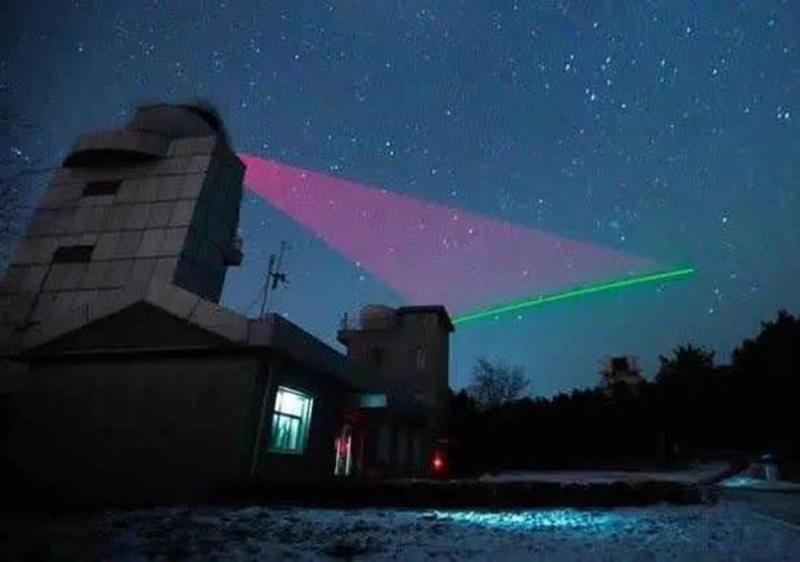
Figure: China’s quantum radar detection diagram/network picture
Radar is known as the "clairvoyance". In modern information warfare where discovery means attack, being able to detect opponents faster and more accurately is even more important than attacking them. Recently, a number of new radars developed by China have been publicly unveiled, including quantum radar, microwave photon radar, and airborne radar that can "look backward"... Among them, the quantum radar that was publicly displayed for the first time has become the focus of the outside world because it solves the technical bottlenecks of traditional radars in anti-jamming, anti-stealth, and target recognition. At present, China has already completed the development of a quantum radar principle prototype, breaking through the detection limits of similar radars and achieving remote detection for the first time in the world.
From visual range warfare in the past, to beyond visual range warfare, to information-based warfare, almost every country in the world is developing its own radar equipment. After 60 years of development, Chinese radar has made qualitative breakthroughs from the previous electromagnetic radar and infrared radar to the current quantum radar. Mainland media reports indicate that China currently has preliminary capabilities in quantum radar system design, system development and experimental verification in terms of quantum radar research.
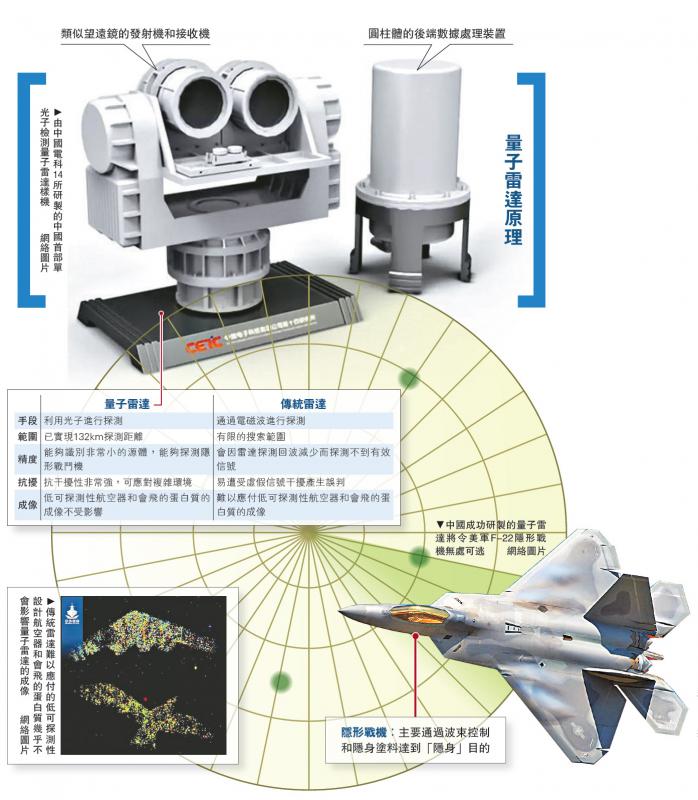
According to reports from Xinhua News Agency and the People's Liberation Army Daily, China's first quantum radar prototype has been publicly unveiled at the Zhuhai Air Show and the Beijing Radar Summit Forum. This radar is China’s first single-photon detection quantum radar prototype developed by China Electronics Technology 14th Institute. According to online information, conventional radar only uses electromagnetic waves, and its search range and effect are limited. Quantum radar can use photons for detection and develop the characteristic advantages of quantum. In addition, quantum radar has very strong accuracy and anti-interference performance. Especially in complex environments, it can identify very small sources and can also detect stealth fighter jets.
The 132km range is far beyond that of optoelectronic equipment
According to a report in Science and Technology Daily in August this year, as early as 2015, after the development team of the 14th China Electronics Technology Institute completed the development of a quantum radar principle prototype, it carried out a long-range detection test on the northwest plateau, breaking through the detection limit of similar radars and achieving long-range detection for the first time in the world.
Recently, Wang Jianming, deputy director of the 14th Institute of Electronic Technology of China, expert of the subject expert group of the Military Commission Science and Technology Commission, and chief expert of the National Defense 973 Project, revealed in the paper "Radar Systems and Technologies for Next-Generation Warfare" published in the magazine "Modern Radar" that China used a quantum radar system based on superconducting single photon detectors to carry out detection tests in a real atmospheric environment in Qinghai Lake, with a target detection range of 132km.
Industry analysts generally believe that this distance has far exceeded the capabilities of traditional photoelectric detection equipment, making up for the shortcomings of insufficient detection distance when traditional photoelectric detection systems work with classic source radar systems, and is at the leading level in the country and even the world.
Wang Jianming introduced that quantum radar introduces quantum technology into the field of radar detection. Through the utilization of quantum resources, it achieves high-sensitivity detection and high-dimensional quantum state modulation, and solves the technical bottlenecks of traditional radar in anti-interference, anti-stealth and target recognition. The authoritative expert revealed that quantum radar has the advantages of long detection range, low transmission power, rich detection methods, and strong anti-interference ability. It has potential application prospects in new airborne long-range anti-stealth early warning systems, UAV anti-missile systems and other fields.
Quantum technology will use the microwave frequency band
Wang Jianming said frankly that at present, basic technologies such as quantum detection theoretical architecture and quantum components need to be tackled, and the practical use of quantum radar is still some way off. However, Hu Mingchun, director of the 14th Institute of China Electronics Technology, also said in a recent interview with CCTV during the Zhuhai Air Show that the next step is to use quantum radar technology in the microwave frequency band to increase the detection range of the widely used microwave radar and improve the anti-interference performance of the radar. He revealed that while quantum radar is detecting, it can also interfere with the opponent's radar and can also meet communication needs. He hopes that relevant results can be applied to the People's Liberation Army's main battle radar as soon as possible to improve the Chinese army's early warning and detection capabilities.
Quantum radar principle
"Silk Road Eye" can monitor satellites or export Pakistan Railway
China's independently developed new "Silk Road Eye" early warning aircraft radar also made its first public appearance in Zhuhai a few days ago. According to China Electronics Technology Co., Ltd. 14, the "Silk Road Eye" active phased array early warning aircraft radar is actually an early warning aircraft system that can be installed on various large aircraft platforms. It can be installed on Airbus, Boeing or other platforms according to user needs.
The early warning aircraft is an important piece of equipment in modern air combat. It is the command center of air combat. It not only serves as an early warning detection platform, but also an important means for interconnecting various types of information and equipment. It is known as the "Commander in the Air" and has important strategic significance. The American think tank "China Briefing" evaluated that China's early warning aircraft radar is one generation ahead of foreign countries in terms of technical system.
The "Silk Road Eye" radar antenna uses two back-to-back active phased array antennas, of which the back one has a smaller number of T\R units. According to reports, the antenna with more units on the front can not only monitor air and sea targets, but also track and monitor targets in nearby space and orbit. It has the capabilities of anti-missile and monitoring low-orbit satellites. When performing this task, the antenna can be pointed in the direction of the main threat, and the radar antenna on the back can also ensure that the early warning aircraft will not have a "blank field of view" when monitoring targets in a specific direction.
According to Observer.com, Pakistan may become the first overseas user of the "Silk Road Eye" to modify its existing ZDK-003 early warning aircraft to greatly improve its performance. Due to its advanced performance and luxurious configuration, the "Silk Road Eye" radar can be used by users with high-end needs. Compared with early warning aircraft such as the E-2 "Hawkeye", E-3 "Wangtower" or "Erie Eye", its performance has considerable advantages.
Microwave photon radar resolution increased by a hundred times
The Microwave Photonics Project Team of the Intelligent Perception Laboratory of the 14th Institute of China Electronics Technology has completed phased research on the long-standing problem of insufficient instantaneous dynamics of microwave photonic radars, developed a millimeter-wave large dynamic broadband radar, and completed high-resolution imaging of civil aviation aircraft. Compared with internationally reported microwave photonic radar prototypes, the reception dynamics have been improved by 4 times, and the resolution has been increased by 100 times.
The development of microwave photonics technology is a potentially disruptive technology in the radar field and an important technical support for a new generation of multi-functional, software-based radar. As early as 2014, international peers announced the world's first all-photon architecture radar system prototype, verifying the feasibility of using photon technology to implement radar systems. However, although photonic technology had the ability to achieve ultra-wide spectrum coverage at that time, its deterioration in system dynamics was still more serious than that of a pure microwave system.
The United States, Russia, Italy, China, etc. have conducted research on microwave photon radar. In a recent Italian dual-band microwave photon radar field test, it successfully detected multiple maritime targets and accurately tracked ships 8 nautical miles away. The minimum detectable signal reached -122dBm and -124dBm in the S and X bands respectively, which is equivalent to the most advanced coherent radar system. Russia revealed that it has successfully developed a microwave photon radar transceiver prototype, and Nanjing University of Aeronautics and Astronautics, Nanjing Institute of Electronic Technology, and the Chinese Academy of Sciences have also developed a microwave photon real-time imaging verification system.
Wang Jianming, deputy director of the 14th Institute of China Electronics Technology, expert of the subject expert group of the Military Commission Science and Technology Commission, and chief expert of the National Defense 973 Project, pointed out that microwave photon radar uses microwave photon technology to replace the radio frequency microwave link based on electronic technology in traditional radar, which can effectively overcome the technical bottleneck of traditional electronic devices and meet the technical needs of multi-band, large bandwidth, anti-interference, reconfigurable and multi-functional radar. Radar arrays that can achieve lightweight and miniaturization can be used as smart skins for next-generation fighter jets and unmanned airships.
The airborne radar adds a "rear eye" to help the fighter aircraft become "stealth"
Recently, China Electronics Technology Co., Ltd. 14 twice grandly introduced the new KLJ-7A "three-sided array" airborne active phased array fire control radar on its WeChat public account. Compared with the ±60̊ field of view of traditional radar, the KLJ-7A "three-sided array" radar has a detection field of view that has been greatly improved by installing two ultra-thin antennas on both sides of the fuselage, reaching ±150̊ (i.e. 300̊ detection field of view). It provides modern fighters with one of the "wide-angle" solutions that breaks through the limitations of traditional field of view. Compared with traditional radar, it allows fighter aircraft to obtain the disruptive skill of "rear eye" and improves their battlefield perception capabilities by geometric orders of magnitude.
According to experts from 14 institutes, aircraft with "wide-angle" capabilities can effectively maintain control of the enemy's situation in air combat, thereby planning routes so that the aircraft coincides with the opponent's speed vector, so that enemy fighters cannot control their own whereabouts. To a certain extent, this is another kind of "stealth", which is of great significance to improving tactical flexibility.
Secondly, the "wide-angle" field of view can help fighter aircraft achieve "agile separation" in actual combat, that is, reliably and stably track targets and guide advanced air-to-air missiles at large angles and large maneuvers, so that our own aircraft can "run and fight", greatly improving their survivability.
In addition, the "wide-angle" field of view can also expand the radar's search range and be used as a "small early warning aircraft" to a certain extent.
"With the 'wide-angle' capability, the three-sided array KLJ-7A not only greatly improves the fighter's detection performance, but more importantly, these capabilities greatly enrich the fighter's combat flexibility and battlefield survivability, thereby taking the combat capability of the aircraft to a higher level." Experts from the 14th Institute pointed out that the KLJ-7A is an important breakthrough in the field of airborne fire control radar, marking that China's airborne fire control radar technology has reached the world's advanced level, and has achieved leadership in some aspects.





